Why AI Video Will Never Replace Authentic India Footage — And What That Means for Indian Creators
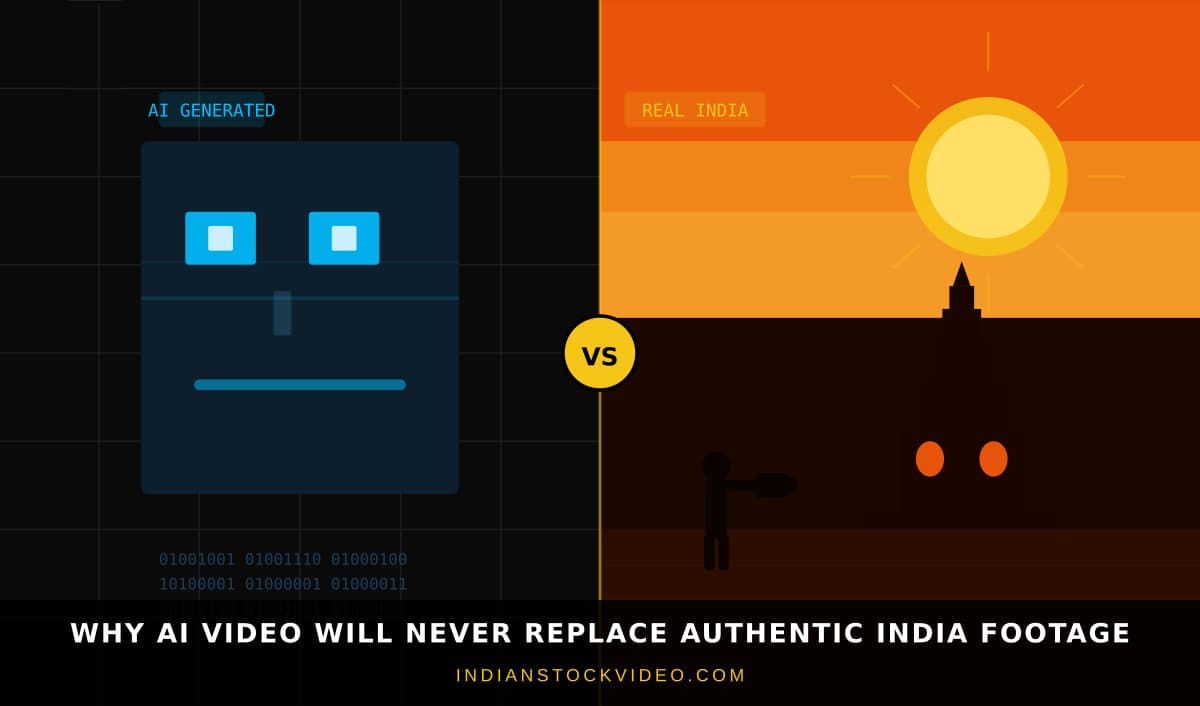
Every few weeks, another article declares that AI video generation has made stock footage obsolete. The argument: tools like Sora, Veo, and Runway can generate photorealistic video from a text prompt in seconds. Why would anyone pay to license footage when they can generate exactly what they need for a fraction of the cost?
It's a compelling argument. It also misses something fundamental about what makes certain footage valuable — and why authentic India content is among the least replaceable categories in the global stock footage market.
What AI Video Generation Is Actually Good At
AI video generation excels at producing generic visual content at speed and low cost. Need footage of a professional looking thoughtfully at a laptop? AI can generate it in seconds. Need a timelapse of clouds over a generic cityscape? Done.
This is genuinely disruptive to a significant portion of the stock footage market. The generic, Western-default content that forms the bulk of platforms like Shutterstock is increasingly replaceable by AI generation.
What AI Video Generation Cannot Do
It hallucinates culture.
Ask any AI video generator to produce footage of the Thrissur Pooram and it will produce something that looks vaguely Indian and vaguely festive. The elephants will probably be present. The details will be wrong. The caparisons will be incorrect for the region. The specific umbrella patterns of the Kudamattam display will be absent.
To an international viewer, this passes. To an Indian viewer — particularly one from Kerala — it's immediately and obviously wrong. This isn't a temporary limitation that will be resolved in the next model update. AI generates India by averaging everything it has seen labelled as "India." That average is not the Thrissur Pooram. It's a blur.
It cannot document what has never been documented.
The living root bridges of Meghalaya. The Hornbill Festival in Nagaland. The specific moment of the Ganga Aarti at Dashashwamedh Ghat as the sun sets. These moments exist in the physical world. They cannot be generated because they haven't been comprehensively documented in the training data that AI learns from.
The Authentication Problem
Indian audiences — particularly the highly culturally literate middle class that most brands are targeting — are increasingly sensitive to inauthenticity. A brand using AI-generated "Indian" footage that doesn't look quite right sends a signal, even if viewers can't articulate exactly what's wrong: this brand doesn't actually know us.
As AI-generated content becomes more common, authenticity becomes more valuable, not less. The footage that proves something real happened gains value precisely because the alternative is ubiquitous and obviously synthetic.
What This Means for the Indian Stock Footage Market
The stock footage market is bifurcating. One half — generic, context-free visual content — is being commoditised rapidly by AI. The other half — specific, culturally authentic, real-world footage — is becoming more valuable. Not despite AI, but because of it.
India sits almost entirely in the second category. Authentic footage of India's cultural diversity, regional festivals, and traditional crafts cannot be AI-generated convincingly enough to pass the cultural authentication that Indian audiences apply to content.
What This Means for Indian Videographers
If you're an Indian videographer wondering whether it's worth building a stock footage portfolio in an era of AI generation, the answer is emphatically yes.
The footage that you can produce — real moments from real Indian places, shot with local knowledge and cultural understanding that no AI model possesses — is exactly the footage that cannot be replaced. The Bihu dance in Assam, the Kalbelia folk performers of Rajasthan, the specific light on the Western Ghats at monsoon season — these cannot be generated. They have to be shot. And they can only be shot by someone with the access, the timing, and the cultural understanding to capture them correctly. That is you.
A Note on Commercial Licensing
AI-generated footage from most current platforms carries uncertain intellectual property status and has restricted commercial licensing for certain use categories — particularly journalism, documentary, and advertising contexts where authenticity claims matter legally.
Footage licensed from a stock library carries a clear rights trail: who shot it, when, where, and under what terms. For brands and documentary teams where license compliance is non-negotiable, this matters. Authentic, licensed stock footage of India isn't just culturally superior — it's legally cleaner.
The Summary
AI video generation is genuinely transformative for generic stock content. For authentic, culturally specific Indian footage, it is not a replacement. It is, if anything, a mechanism for making the authentic more valuable by contrast.
The footage of India that only Indians can shoot is the footage that the global market will increasingly pay for. Build that library.